SEO Keyword Research Made Simple for 2026
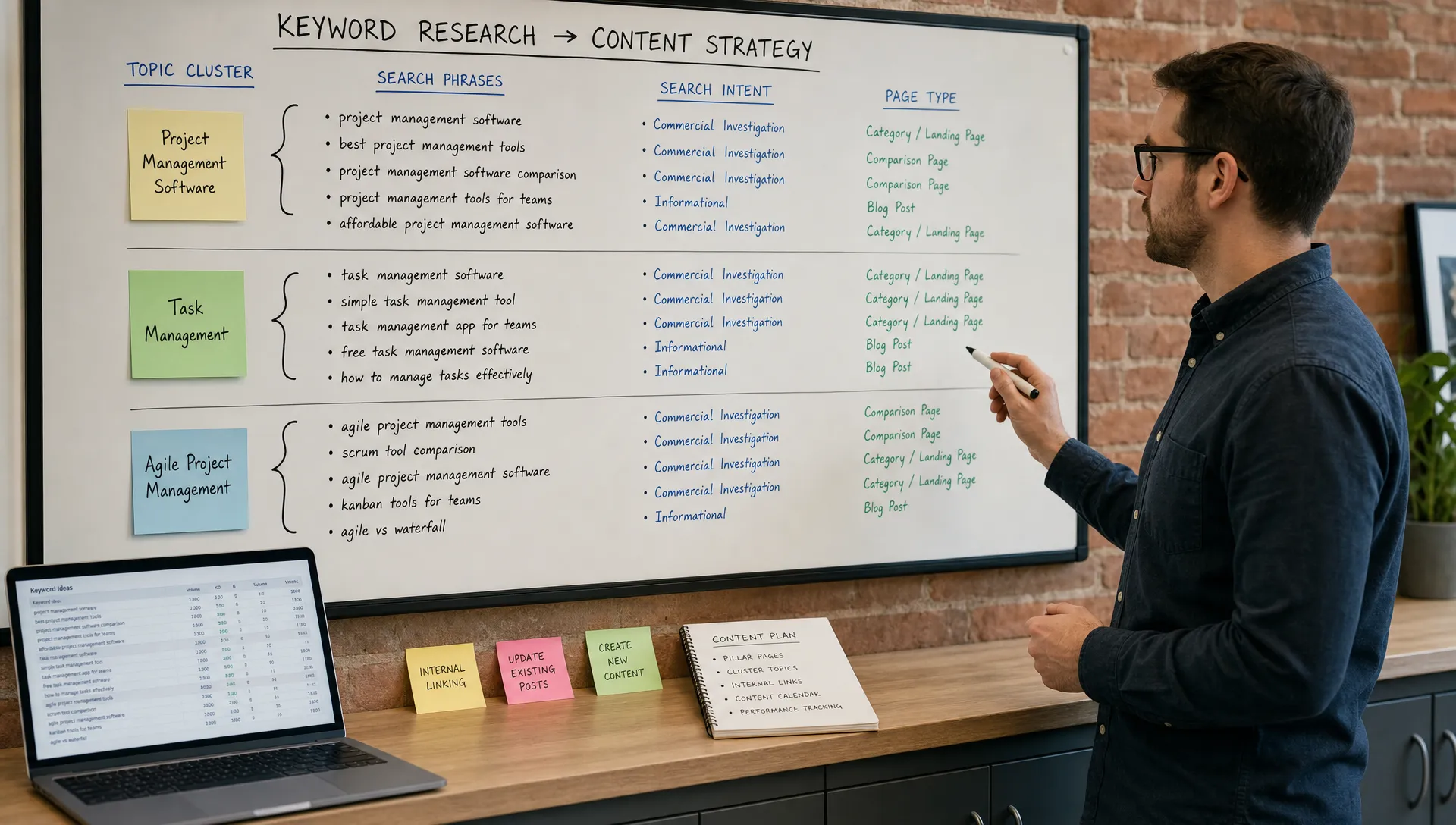
SEO keyword research used to mean exporting a giant spreadsheet, sorting by search volume, and hoping the highest-volume phrase would bring traffic. That approach is too blunt for 2026.
Search now happens across Google results, AI summaries, shopping platforms, video platforms, forums, local packs, and chat-style answer engines. The best keyword research is not about finding the biggest keyword. It is about finding the right query, understanding what the searcher wants, and choosing the page type most likely to satisfy that intent.
This guide gives you a simple, repeatable framework you can use for your own site or for client work, without getting buried in metrics.
What SEO keyword research means in 2026
Keyword research is the process of discovering the words, questions, and topics your audience uses when searching for information, products, services, comparisons, and solutions.
In 2026, that definition needs one important update: keyword research is also about understanding how a query is answered. Sometimes Google shows traditional blue links. Sometimes it shows videos, product grids, map results, forum discussions, AI-generated summaries, or rich snippets. In some cases, users may never click if the answer is simple.
That means modern keyword research should answer five questions:
- Who is searching?
- What problem are they trying to solve?
- What type of content do they expect?
- How competitive is the result page?
- Is the keyword valuable enough to target?
Google’s own guidance emphasizes creating helpful, reliable, people-first content rather than content built only to attract search engines. You can see this reflected in Google Search Central’s helpful content guidance, which is a useful reminder that keyword research should support useful content, not replace it.
Start with the audience before the tool
Before opening a keyword tool, define the people you want to reach. This is the step many SEO campaigns skip, and it is why so many content calendars become bloated with low-value topics.
A strong keyword strategy starts with audience context. For each audience segment, write down what they already know, what they are trying to achieve, what objections they have, and what action you eventually want them to take.
For example, an SEO agency researching keywords for an accounting software client should not start with “accounting software” alone. That phrase is broad and competitive. Better starting points may include “bookkeeping software for contractors,” “how to track expenses for a small business,” or “QuickBooks alternatives for freelancers,” depending on the client’s positioning.
Use this simple starting table:
| Planning question | Why it matters | Example answer |
|---|---|---|
| Who is the searcher? | Prevents generic content | Freelance designers managing invoices |
| What problem do they have? | Reveals useful topics | They need faster expense tracking |
| What do they already know? | Sets content depth | They know spreadsheets are slow |
| What page type fits? | Matches search intent | Comparison guide or feature page |
| What business outcome matters? | Keeps SEO tied to revenue | Trial signup, lead, or demo request |
This keeps your research grounded. A keyword with 200 monthly searches from your ideal buyer can be worth more than a keyword with 20,000 searches from the wrong audience.
Build a seed keyword list from real language
Seed keywords are the starting phrases you use to expand your research. They should come from real customer language whenever possible.
Good sources include sales calls, support tickets, customer reviews, competitor pages, Google Search Console queries, forum threads, YouTube titles, Reddit discussions, and internal site search logs. If you already have a website, the Performance report in Google Search Console can show queries where you are getting impressions but not enough clicks.
A practical seed list usually includes:
- Product or service terms, such as “SEO audit tool” or “content brief generator”
- Problem terms, such as “why is my page not ranking”
- Comparison terms, such as “Ahrefs vs Semrush”
- Use-case terms, such as “keyword research for ecommerce”
- Audience modifiers, such as “for freelancers,” “for agencies,” or “for local businesses”
- Urgency modifiers, such as “checklist,” “template,” “free,” “best,” or “near me”
Do not worry about volume yet. At this stage, you are collecting language and patterns. You will prioritize later.
Expand keywords into topics, not just variations
Once you have seed keywords, expand them into topic clusters. A topic cluster is a group of related queries that can be served by one main page and several supporting pages.
For example, the seed keyword “SEO keyword research” can expand into related topics like “how to find keywords,” “keyword intent,” “long-tail keywords,” “keyword difficulty,” “keyword mapping,” and “keyword research checklist.” Some of those can fit inside one guide. Others may deserve their own page if the intent is distinct.
The goal is not to create one page for every tiny variation. That often leads to thin, overlapping content. Instead, group similar queries by intent.
| Keyword group | Searcher intent | Best content format |
|---|---|---|
| “what is keyword research” | Learn the basics | Beginner guide |
| “how to do keyword research” | Follow a process | Step-by-step tutorial |
| “best keyword research tools” | Compare options | Tool list or comparison page |
| “keyword research for ecommerce” | Apply to a specific use case | Specialized guide |
| “free keyword research template” | Get an asset | Template landing page |
If two keywords have the same search intent and the same top-ranking page types, they often belong on the same page. If the SERPs look very different, they probably need separate pages.
Use the SERP to confirm intent
Keyword tools can estimate volume and difficulty, but the search results page tells you what Google believes users want.
Search your target keyword manually and look at the top results. Are they blog posts, product pages, category pages, videos, local listings, comparison pages, or forum threads? Are the results beginner-friendly, advanced, recent, visual, or opinion-based?
This is especially important because keyword wording can be misleading. A phrase like “email marketing automation” may sound informational, but the SERP might be dominated by software landing pages and comparison posts. A phrase like “how to improve email open rate” is more likely to need a practical guide.
Pay attention to these SERP clues:
- Page type ranking in the top positions
- Featured snippets or AI summaries
- People Also Ask questions
- Video or image results
- Product grids or shopping results
- Local map packs
- Forums and user-generated content
- Dates on ranking content
If the SERP is full of fresh 2026 guides, older content may struggle unless it is updated. If the SERP is full of product pages, a top-of-funnel blog post may not satisfy intent. If forums rank highly, searchers may want firsthand experience, candid opinions, or troubleshooting details.
Score keywords with a simple opportunity model
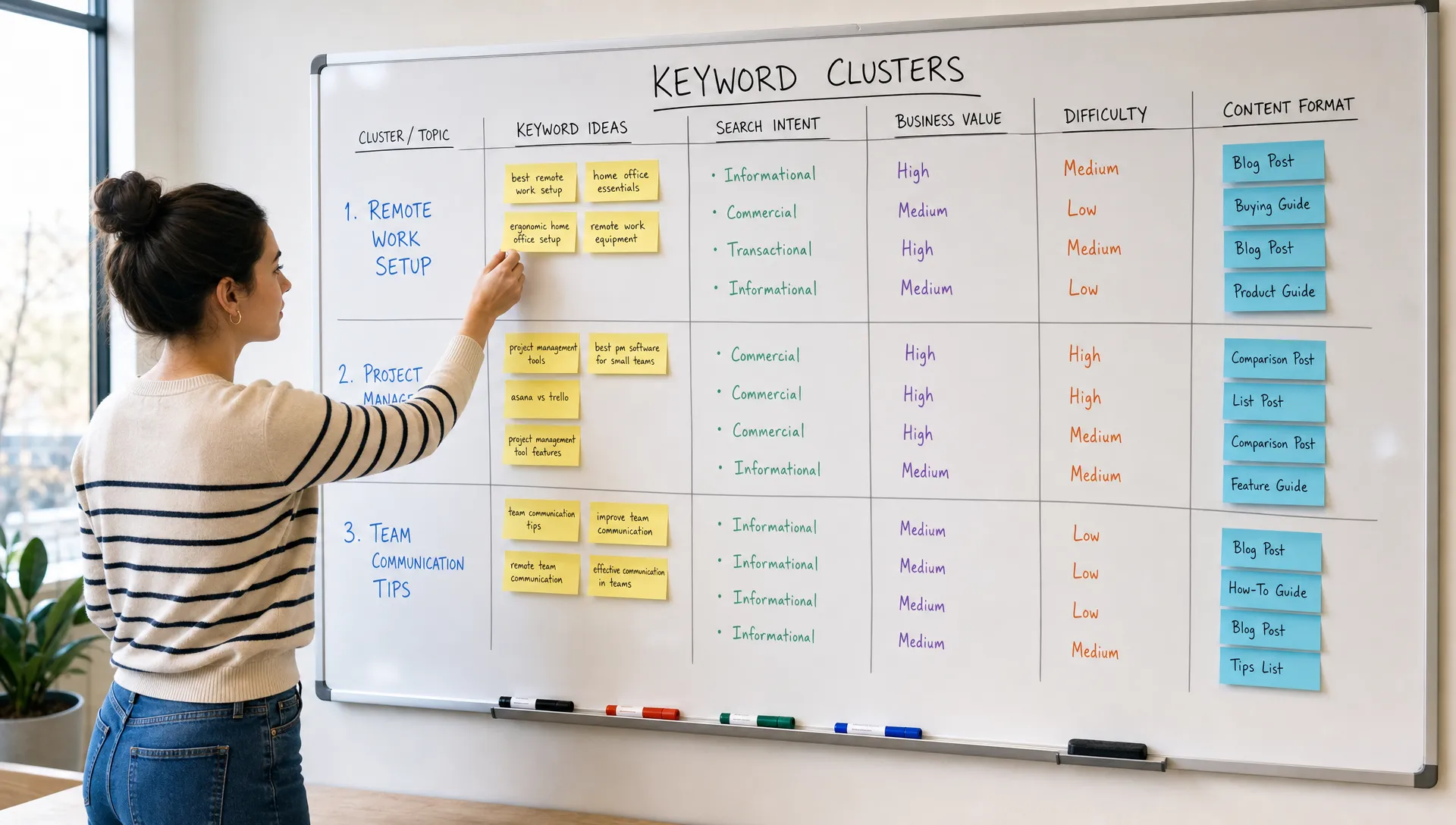
After collecting and grouping keywords, you need to decide what to target first. Search volume matters, but it should never be the only factor.
A simple 1 to 5 scoring model works well. Give each keyword or topic a score for business value, ranking feasibility, intent clarity, content fit, and traffic potential. Then prioritize the topics with the best combined score.
| Factor | What to ask | High score means |
|---|---|---|
| Business value | Could this searcher become a lead, customer, subscriber, or buyer? | The keyword is close to a useful conversion |
| Ranking feasibility | Can your site realistically compete? | Your authority and content quality can match the SERP |
| Intent clarity | Is it obvious what the searcher wants? | The right page type is easy to define |
| Content fit | Can you create something genuinely useful? | You have expertise, examples, data, or a unique angle |
| Traffic potential | Could the topic attract meaningful visits? | The topic has demand beyond one exact phrase |
This model helps avoid two common traps. The first is chasing huge keywords that are too competitive. The second is publishing easy keywords that bring visitors who will never care about your offer.
Map keywords to the buyer journey
Not every keyword should lead to a blog post. Some should become landing pages, comparison pages, category pages, templates, glossaries, or support content.
Think of your keywords across three broad stages:
| Journey stage | Search behavior | Example keyword | Best page type |
|---|---|---|---|
| Awareness | The user is learning about a problem | “why is my organic traffic dropping” | Educational guide |
| Consideration | The user is comparing solutions | “best SEO audit tools for agencies” | Comparison or listicle |
| Decision | The user is ready to act | “free SEO audit tool” | Tool page or landing page |
A healthy SEO strategy includes all three stages. Awareness content builds trust and topical authority. Consideration content captures buyers comparing options. Decision content converts demand that already exists.
For agencies and freelancers, this mapping also makes client conversations easier. Instead of saying, “We need 20 blog posts,” you can say, “We need four awareness pages, three comparison assets, two service pages, and one template to cover this buying journey.”
Choose a primary keyword and supporting terms
Each important page should have one primary keyword. This is the clearest phrase that represents the page’s main intent. It does not need to be repeated awkwardly. It simply guides the title, URL, introduction, headings, and overall focus.
Supporting terms help you cover the topic naturally. These may include synonyms, subtopics, questions, entities, and related problems. For a page targeting “SEO keyword research,” supporting terms may include “search intent,” “long-tail keywords,” “keyword difficulty,” “topic clusters,” and “SERP analysis.”
The key is to use supporting terms because they help the reader, not because a tool says to force them in. After drafting, you can use a tool like the free Keyword Density Checker to spot unnatural repetition, missing phrase patterns, or accidental keyword stuffing.
Keyword density is not a ranking formula. It is a quality control check. If your primary phrase appears so often that the content sounds robotic, rewrite it. If your page never clearly uses the language searchers use, make it clearer.
Build a keyword map before writing
A keyword map connects each target topic to a specific URL. This prevents cannibalization, where multiple pages on your site compete for the same intent.
Your keyword map does not need to be complicated. A spreadsheet with URL, primary keyword, intent, funnel stage, page type, and status is enough.
| URL or planned page | Primary keyword | Intent | Funnel stage | Action |
|---|---|---|---|---|
| /blog/keyword-research-guide | SEO keyword research | Learn process | Awareness | Create or update |
| /tools/keyword-generator | keyword generator | Use tool | Decision | Optimize landing page |
| /blog/keyword-intent | keyword intent | Understand concept | Awareness | Create support article |
| /blog/best-keyword-tools | best keyword research tools | Compare tools | Consideration | Build comparison |
Before creating a new page, check whether an existing URL already satisfies the same intent. If it does, update the existing page instead of publishing a near-duplicate. If the page is live but underperforming, run a broader diagnostic with an AI SEO audit such as SEO Autopilot to identify technical, content, and on-page issues that may be holding it back.
Make keyword research work for AI search visibility
AI search does not remove the need for keyword research. It changes what you look for.
People ask AI systems longer, more specific questions. Instead of typing “keyword research,” they might ask, “How should a new SaaS startup prioritize SEO keywords with no domain authority?” These conversational queries reveal context, constraints, and decision criteria.
To adapt your research for AI visibility, collect questions and prompts as well as traditional keywords. Look for patterns in how users describe their situation. Then create content that gives concise, well-structured answers backed by experience, examples, and sources.
Useful AI-era keyword research inputs include:
- Full questions from People Also Ask, forums, and customer chats
- Comparison prompts, such as “best option for X vs Y”
- Constraint-based searches, such as “for small teams” or “without coding”
- Troubleshooting searches, such as “why is my page indexed but not ranking”
- Definition searches that need clear, quotable answers
There is no guaranteed way to be cited by an AI answer engine. However, clear structure, original insight, accurate facts, named entities, and concise answer blocks can make your content easier to understand, reference, and retrieve.
Create content briefs from your keyword research
A good content brief turns keyword data into writing direction. It should not be a dump of phrases. It should explain the searcher, the intent, the angle, and the page structure.
At minimum, include the primary keyword, secondary topics, target audience, search intent, recommended page type, must-answer questions, internal links, external sources, and conversion goal.
For structure, review the pages currently ranking and identify what they cover well, what they miss, and what you can add that is more useful. That might be a clearer process, a better example, a decision framework, a downloadable template, firsthand experience, or more current information.
Once the draft is ready, check that the headings reflect the reader’s journey. A clear H1-H6 hierarchy helps both users and search engines understand the page. If you need a quick review, the free Heading Tag Checker can help identify skipped levels, multiple H1s, and confusing heading structure.
Common keyword research mistakes to avoid
The simplest keyword research process is often the most effective, but a few mistakes can derail it.
Chasing volume without intent is the biggest one. A high-volume keyword that attracts the wrong audience wastes content resources. Another mistake is ignoring low-volume long-tail searches. These queries often reveal highly specific buyer needs, especially in B2B, local SEO, and niche ecommerce.
Cannibalization is another issue. If five pages target the same intent, none of them may perform as well as one strong, consolidated page. This is why keyword mapping matters.
Also avoid copying competitors too closely. Competitor research is useful, but your content needs its own reason to exist. Add examples, data, opinions, product experience, templates, or a clearer framework.
Finally, do not treat keyword research as a one-time task. Search behavior changes, SERPs change, competitors update content, and new AI interfaces influence how people phrase questions. Revisit your keyword map at least quarterly for important sites.
A simple 2026 keyword research workflow
If you want a practical process, use this workflow:
- Define the audience, offer, and business goal.
- Collect seed keywords from customers, competitors, Search Console, and SERPs.
- Expand seeds into questions, modifiers, comparisons, and use cases.
- Group keywords by search intent and topic cluster.
- Inspect the SERP to confirm page type and competition.
- Score each topic by business value, feasibility, intent clarity, content fit, and traffic potential.
- Map each keyword group to a new or existing URL.
- Create a brief, write the page, optimize headings, and review for natural keyword use.
- Track rankings, clicks, conversions, and content gaps over time.
This workflow keeps keyword research focused on decisions. You are not collecting keywords for the sake of collecting keywords. You are deciding what to publish, what to update, what to merge, and what to ignore.
Frequently Asked Questions
What is SEO keyword research? SEO keyword research is the process of finding and analyzing the words, phrases, and questions people use in search engines so you can create pages that match their intent and support your business goals.
Is keyword research still important in 2026? Yes. Even with AI search and changing SERP layouts, keyword research remains essential because it reveals audience language, search intent, topic demand, and content opportunities.
How many keywords should one page target? One page should usually have one primary keyword or topic, plus related supporting terms. The goal is to satisfy one clear search intent, not to force dozens of unrelated keywords onto the same page.
Are long-tail keywords still worth targeting? Yes. Long-tail keywords often have lower search volume, but they can show clearer intent and stronger business value. They are especially useful for niche websites, local SEO, ecommerce filters, and B2B content.
How often should I update keyword research? Review priority keyword maps quarterly, or sooner if rankings drop, competitors update content, new products launch, or search results change significantly.
Make keyword research easier with SEO Fragments
SEO keyword research does not need to be complicated. Start with your audience, group keywords by intent, validate the SERP, and prioritize topics that can actually move your business forward.
If you want help turning research into action, SEO Fragments offers free AI-powered SEO tools for keyword research, content creation, technical audits, ecommerce SEO, AI visibility tracking, and more. Use it to speed up the repetitive parts of SEO while keeping strategy, judgment, and quality at the center of your workflow.
Building 120+ free AI-powered SEO tools — every article is written and tested with them. About us
Try the tools we used
All articles are written with SEO Fragments. Sign in free and use the same tools.
Get started free →Read next
- Best Semrush SEO Tools Alternatives for Lean TeamsSemrush is a capable platform. For many SEO teams, that is exactly the problem. A full suite can be valuable when you have specialists for keyword research, te…
- 10 SEO Optimization Tools That Actually Save TimeThe best SEO stack is not the one with the most subscriptions. It is the one that removes repetitive work, shortens the path from diagnosis to action, and help…
- Best SEO Tools for Agencies, Freelancers, and CreatorsThe best SEO tools are not always the ones with the biggest dashboards or the longest feature lists. The best stack is the one that helps you make better decis…