The 9 Best AEO Tools to Track AI Citations in 2026
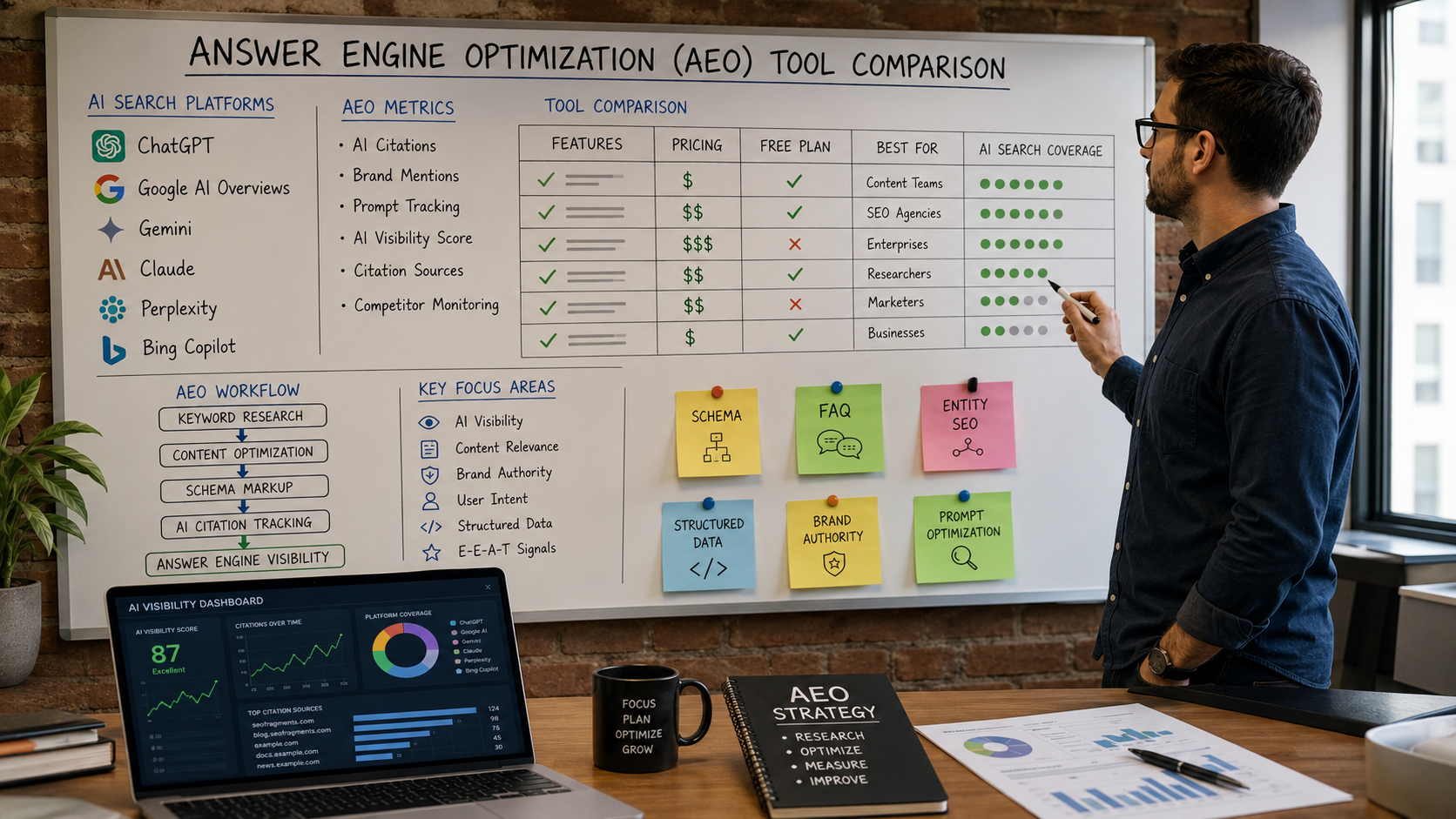
The best AEO tools in 2026 are Profound, Otterly.AI, Peec AI, Scrunch AI, SE Ranking, Semrush AI Toolkit, Ahrefs Brand Radar, Nightwatch, and SEO Fragments. Each one tracks whether AI engines like ChatGPT, Perplexity, and Google AI Overviews mention and cite your brand — a signal traditional SEO tools cannot see. The right pick depends on your budget, your team size, and whether you want to monitor citations, improve them, or both.
Answer engine optimization (AEO) tools exist because search changed under our feet. Google's AI Overviews now answer the question before anyone scrolls, and a growing share of buyers ask ChatGPT instead of Google at all. If you can't measure whether AI cites you, you're flying blind on the fastest-growing part of search. This guide compares the nine tools worth your time, what each one measures, and how to choose — including the honest trade-offs most vendor roundups skip.
Key takeaways
- AEO tools track brand mentions and citations across AI engines (ChatGPT, Perplexity, Gemini, Copilot, Google AI Overviews) — something Ahrefs and Semrush's classic reports never measured.
- Google users click a traditional link in only 8% of searches that show an AI summary, versus 15% without one — a near-halving of clicks (Pew Research, via Search Engine Land).
- Enterprise tools (Profound) go deepest but are demo-only; self-serve tools (Otterly.AI, Peec AI, SE Ranking) start under $100/month; SEO Fragments offers free citation tracking for solo operators.
- Only 34.5% of ChatGPT answers use live search — the rest rely on training data (Semrush), so a good AEO strategy targets both live citations and long-term brand presence.
- Pick by job-to-be-done: monitoring, optimization, or an all-in-one that also handles classic SEO.
What is an AEO tool, and why does it matter now?
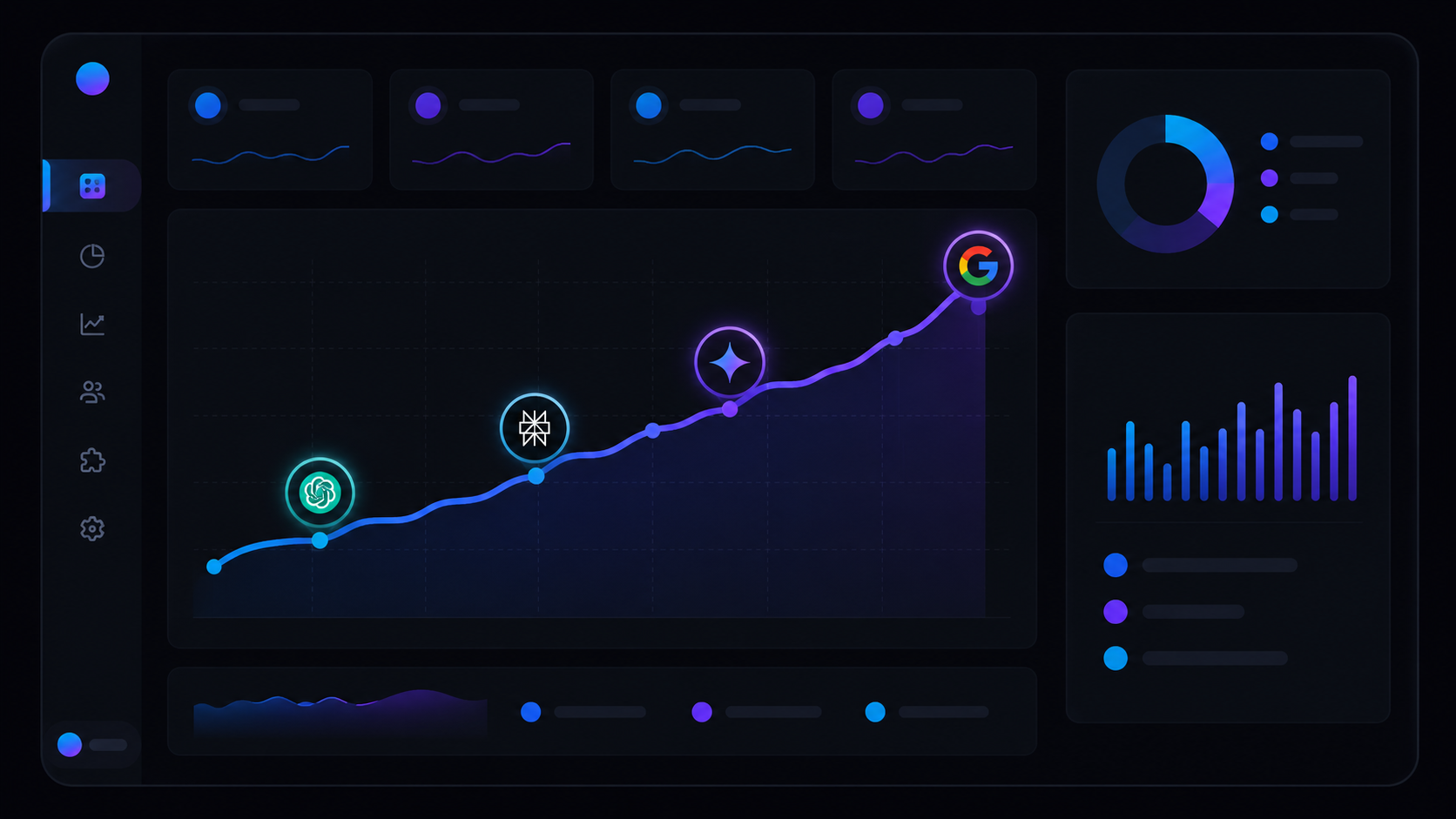
An AEO tool tracks whether AI answer engines mention and cite your brand when people ask them questions. It runs prompts through models like ChatGPT, Perplexity, Gemini, and Google AI Overviews, then reports how often you appear, where you rank against competitors, and whether the answer links back to your site.
This matters because the click is disappearing. Gartner predicts traditional search engine volume will drop 25% by 2026 as AI chatbots absorb queries that used to go to Google (Gartner). Pew Research found that when an AI summary appears, users click a traditional result only 8% of the time — down from 15% — and click a source inside the summary just 1% of the time. Ranking #1 means less every quarter if the AI answer above you never names you.
Classic tools measure the old game. Ahrefs and Semrush's core reports were built for blue links and backlinks, not for "did ChatGPT recommend you." AEO tools measure the new game: your visibility inside the answer itself.
Citation capsule: An AEO tool measures whether AI engines cite your brand in their answers — a metric traditional SEO tools like Ahrefs and Semrush were never built to track.
What should a good AEO tool measure?
Before comparing products, know what separates a real AEO tool from a dashboard with an "AI" label. Five capabilities matter most, and every tool below is judged against them.
- Multi-engine coverage. It should track at least ChatGPT, Perplexity, Google AI Overviews, and Gemini — not one engine in isolation. Your buyers don't all use the same assistant.
- Citation vs. mention. A mention names you; a citation links to you. Good tools separate the two, because a mention with no link still shapes buyer perception.
- Share of voice. It should show your visibility against named competitors for the same prompts, so you know if you're winning or only present.
- Prompt-level detail. You need to see the exact questions where you appear and where you're missing, grouped by topic — that's your content roadmap.
- Sentiment and accuracy. Being cited badly is a problem. Strong tools score whether the AI describes you positively and gets your facts right.
A tool that does one or two of these is a monitor. A tool that does all five is a workbench you can act from. Keep this list open as you read the comparison.

The 9 best AEO tools in 2026 (compared)
Here's the shortlist at a glance, then a plain-English breakdown of each — who it's for and where it falls short.
| Tool | Engines tracked | Best for | Starting price |
|---|---|---|---|
| Profound | ChatGPT, Perplexity, Gemini, AI Overviews, Copilot | Enterprise brands with budget | Demo / custom |
| Otterly.AI | ChatGPT, Perplexity, AI Overviews, AI Mode, Gemini, Copilot | SMBs wanting self-serve monitoring | Free trial, paid tiers |
| Peec AI | ChatGPT, Perplexity, Gemini, and more | In-house marketing teams | Free trial, paid tiers |
| Scrunch AI | Multi-LLM + AI crawler traffic | Teams optimizing delivery to AI | Free trial / demo |
| SE Ranking | AI Overviews, AI Mode, Gemini, ChatGPT, Perplexity | SEO + AEO in one dashboard | ~$99/mo |
| Semrush AI Toolkit | ChatGPT, Perplexity, Gemini, AI Overviews | Existing Semrush users | Add-on to Semrush |
| Ahrefs Brand Radar | Major AI engines | Existing Ahrefs users | Part of Ahrefs plans |
| Nightwatch | ChatGPT, AI Overviews, Copilot, Perplexity, Claude | Agencies and local SEO | ~$39/mo + AI add-on |
| SEO Fragments | ChatGPT, Perplexity, Gemini, Copilot, Claude | Solo operators and lean teams | Free (bring your own key) |
1. Profound — deepest data, enterprise price. Profound is the tool big brands name first. It covers answer-engine insights, prompt volumes, and even AI agent analytics, and its data depth is hard to match. The trade-off: pricing is demo-only, so it's built for teams with real budget, not a freelancer testing the waters.
2. Otterly.AI — the self-serve favorite. Otterly tracks six engines including AI Overviews and AI Mode, offers a free trial, and is priced for small and mid-size businesses. It's a strong first paid tool. The downside is that its optimization guidance is lighter than enterprise platforms — it tells you where you stand more than exactly how to fix it.
3. Peec AI — built for teams. Peec focuses on marketing teams that want shared dashboards around visibility, position, and sentiment. Collaboration and clean reporting are its strengths. If you're a team of one, you may pay for seats and workflow you won't use.
4. Scrunch AI — monitoring plus delivery. Scrunch pairs multi-LLM monitoring with agent-experience features that shape how AI crawlers consume your site. That makes it useful if you want to act on citations, not only watch them. The breadth adds a learning curve for small teams.
5. SE Ranking — SEO and AEO together. SE Ranking's AI visibility module sits inside a full SEO platform at around $99/month, with competitor insights, source tracking, and sentiment. It's a sensible pick if you want one login for rankings and citations. Its AI depth trails specialist-only tools.
6. Semrush AI Toolkit — for Semrush loyalists. If you already pay for Semrush, its AI Toolkit adds visibility tracking without a new vendor. Convenient and well-integrated. Standalone, though, it's an expensive way to get AEO data alone.
7. Ahrefs Brand Radar — for Ahrefs loyalists. Same logic as Semrush: Brand Radar bolts AI-mention tracking onto a toolset your team already trusts. Best value when you're inside the Ahrefs ecosystem, not as a reason to enter it.
8. Nightwatch — agency-friendly and affordable. Nightwatch combines classic rank tracking, AI visibility as an add-on, and zip-code-level local data from about $39/month. Agencies and local SEOs get a lot for the price. Its AI reporting is newer and less specialized than pure-play AEO tools.
9. SEO Fragments — free citation tracking for solo operators. Disclosure: this is our tool, so weigh it accordingly. SEO Fragments' AI Citation Tracker checks whether ChatGPT, Perplexity, Gemini, Copilot, and Claude mention your brand, scores citation likelihood, and flags competitor gaps — free, using your own API key. The honest limit: it doesn't hold years of historical trend data the way Profound does, and it's built for individuals and lean teams rather than large enterprises.
Citation capsule: For solo operators, free AEO tools like SEO Fragments' AI Citation Tracker cover the basics; enterprise brands that need historical depth and agent analytics turn to Profound; most teams land on a mid-market tool such as Otterly.AI, Peec AI, or SE Ranking.
The nuance most AEO tools miss: training data vs. live citations
Most AEO tools only measure live citations — the moment an engine searches the web and links a source. That misses most of what happens. Semrush found that ChatGPT enables its search feature on only 34.5% of queries; the other roughly two-thirds of answers come straight from training data (Semrush).
That gap changes strategy. If a model answers from memory, no amount of fresh schema on your page helps in that moment — what helps is having been mentioned across the web enough that the model learned your brand. So AEO splits into two jobs: earn live citations now (structured, quotable content the engine can fetch), and build durable brand presence (mentions, reviews, and coverage that seep into the next training run).
When you compare tools, ask which side each measures. A monitor that only reads live citations undercounts your real AI footprint. Pair citation tracking with the broader mention tracking many of these tools also offer.
Citation capsule: Roughly two-thirds of ChatGPT answers rely on training data, not live search, so AEO means earning both fresh citations and long-term brand presence across the web.
How do you choose the right AEO tool?
Match the tool to the job you're hiring it for, not to the longest feature list. Three honest paths cover most people.
- You're solo or testing the water. Start free. SEO Fragments' AI Citation Tracker and a free GEO score audit tell you where you stand at zero cost, so you can prove the problem before you spend.
- You're a growing team. Buy a self-serve specialist: Otterly.AI, Peec AI, or Scrunch AI. You get multi-engine tracking, share of voice, and reporting your team can rally around, usually under a few hundred dollars a month.
- You already live in Ahrefs or Semrush. Turn on their AI module first (Brand Radar or the AI Toolkit) before adding a vendor. If it's too shallow, graduate to a specialist.
One rule holds across all three: run a free trial on your own brand and your real competitors before you commit. Dashboards look identical in a demo; they diverge fast on your actual prompts.
How do you improve AI citations once you're tracking them?
Tracking is step one; the point is to get cited more. A few moves consistently help across engines. Write answer-first: put a complete, quotable answer in the first 40 to 60 words of a page, since engines lift self-contained passages. Add clear structure — headings phrased as questions, short definitions, and FAQ blocks — so a model can extract a clean chunk.
Back claims with real data and name your sources, because engines favor content that looks verifiable. Keep valid schema markup on key pages so machines parse your entities correctly. And earn mentions off-site: reviews, comparisons, and coverage feed the training data that powers those two-thirds of memory-based answers.
If you want the full technical picture, run your site through an AI-focused site audit and read our companion guide on SEO tools that save time.
Conclusion
The best AEO tool is the one that matches your budget and the job you're hiring it for — enterprise depth from Profound, self-serve balance from Otterly.AI or Peec AI, or free citation tracking to start. What matters more than the brand you pick is starting now, while AI citations are still cheap to win and most competitors aren't measuring them at all. Search is moving from blue links to cited answers, and the teams that track their AI visibility today will own the answers tomorrow. Run one free check this week: see whether ChatGPT and Perplexity mention your brand with SEO Fragments' AI Citation Tracker, then decide what to fix first.
Frequently Asked Questions
What is an AEO tool?
An AEO tool tracks whether AI answer engines — ChatGPT, Perplexity, Gemini, Copilot, and Google AI Overviews — mention and cite your brand in their answers. It runs sample prompts, reports how often you appear, compares you to competitors, and shows whether the answer links back to your site.
What are the best AEO tools in 2026?
The strongest options are Profound for enterprise depth, Otterly.AI and Peec AI for self-serve teams, Scrunch AI for optimization, SE Ranking and Nightwatch for value, the Semrush and Ahrefs AI modules for existing users, and SEO Fragments for free solo tracking.
Are there any free AEO tools?
Yes. SEO Fragments offers free AI citation tracking using your own API key, and several paid tools (Otterly.AI, Peec AI, Scrunch AI) provide free trials. Free options cover the basics; historical trend data and agent analytics usually require a paid enterprise plan.
What's the difference between AEO and GEO tools?
AEO (answer engine optimization) focuses on being the cited answer to direct questions in AI chats. GEO (generative engine optimization) focuses on appearing inside longer AI-generated text. Most 2026 tools handle both, so the labels increasingly describe the same product category.
Can I track ChatGPT citations for free?
Yes. SEO Fragments' AI Citation Tracker checks ChatGPT mentions at no cost with your own API key, and tools like Otterly.AI let you test ChatGPT tracking during a free trial. Free tiers limit prompt volume and history compared with paid plans.
Why can't Ahrefs or Semrush's normal reports track AI citations?
Their core reports were built for Google's blue links and backlinks, not for what an AI model says. Both now offer separate AI modules (Brand Radar and the AI Toolkit) to close the gap, but their classic keyword and rank reports still can't see AI answers.
Building 120+ free AI-powered SEO tools — every article is written and tested with them. About us
Try the tools we used
All articles are written with SEO Fragments. Sign in free and use the same tools.
Get started free →Read next
- Answer Engine Optimization: Prepare Content for AI SearchLearn Answer Engine Optimization (AEO) to help AI search engines understand, trust, and cite your content across ChatGPT, Google AI, Gemini, and Perplexity.
- Generative Engine Optimization: How to Get Cited by AITo get cited by AI, give answer engines content they can quote and trust. Lead each section with a direct answer. Back it with real statistics, quotes, and nam…
- AI SEO Audit: How to Audit Your Website in 2026Run a complete AI SEO audit in 2026: what to check, the free tools for each step, and the AI-visibility gaps that classic audits miss. A step-by-step guide.