Answer Engine Optimization: Prepare Content for AI Search
· 9 min read· by Editor
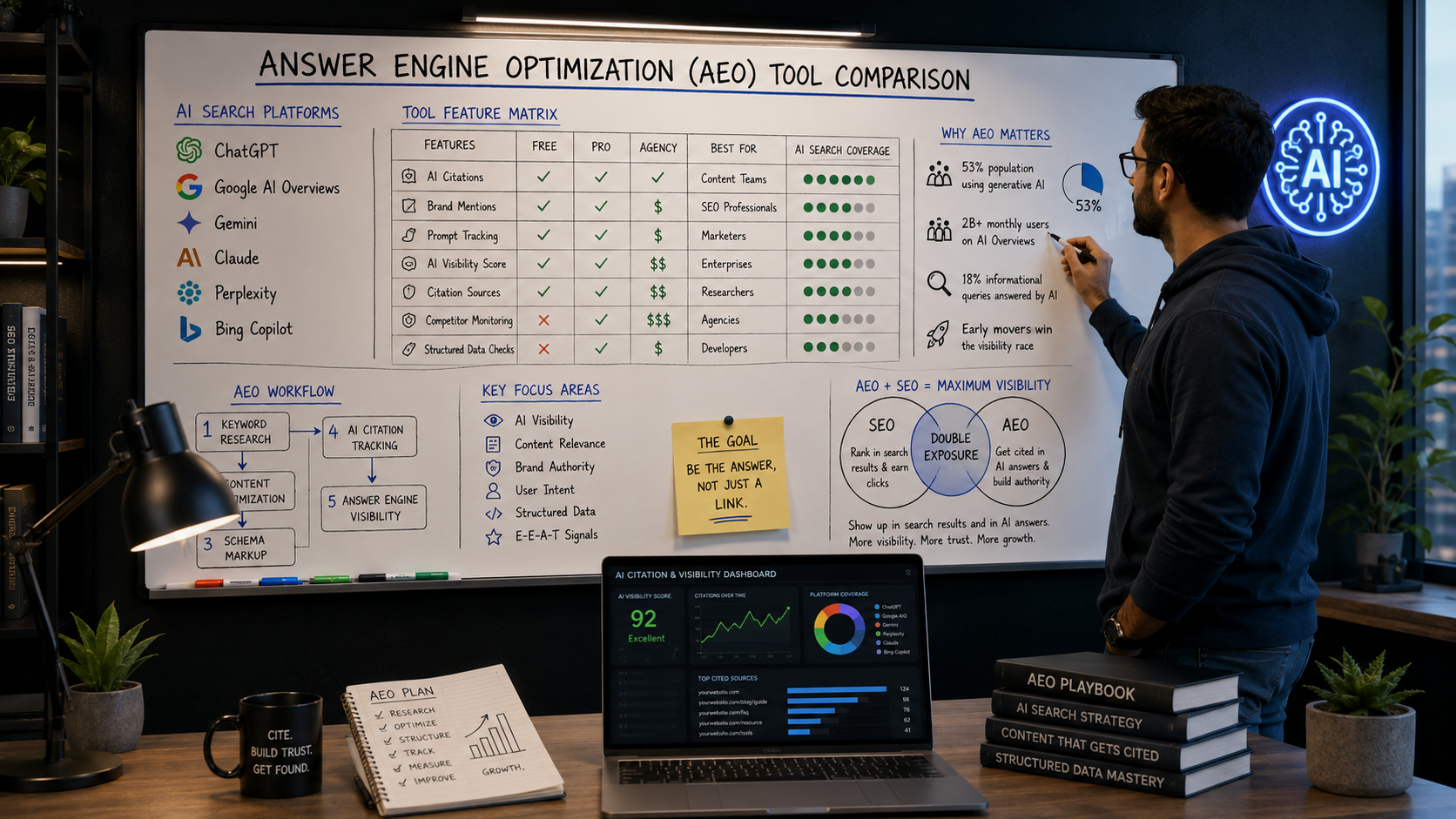
A modern AEO strategy workspace illustrating how businesses optimize content for AI search engines through structured data, schema markup, AI citations, and technical SEO to increase visibility in ChatGPT, Google AI Overviews, Gemini, Claude, and Perplexity.
AI Search is Changing the Way People Find Answers
If you're still primarily optimizing for the blue-link rankings, then you're already behind. ChatGPT hit 1 billion monthly active users back in May 2026, and now answer roughly 18% of informational queries. The difference: AI tools are synthesizing direct answers and giving those to users without a list of links. Your content either gets cited or it doesn't.
What does this mean for your overall strategy?
It isn't about being ranked. It's about getting cited by an AI system as the source for the new first result.
Users no longer click the links. People are reading the answers that these engines synthesize, then moving on after. If the AI doesn't see your content as one it's pulling from—visitors won't know your site exists.
You need to optimize for answer engines (AEO). This means ensuring the AI-enabled engines like Google AI Overviews, ChatGPT, Perplexity, and Gemini know your content and see it as authoritative, understandable, and valuable enough to cite.
opportunity to build authority with AI systems is disappearing fast. We've already seen some early movers showing up in citations. Everyone else is just invisible.
Here's a look at what AEO is, why it matters for your business or client work, and concrete steps to take if you want to start optimizing your content for AI search now.
What Is Answer Engine Optimization?
Answer Engine Optimization is the act of optimizing content so that AI-powered systems can find, understand, trust, and cite it. Imagine it like this: where traditional SEO gets your content on the search results shelf, AEO helps your content be the read-aloud answer—the synthesized answer that precedes a list of links.
You intend to reach users leveraging voice assistants, Perplexity, Gemini, Google's AI Overviews, and ChatGPT. This shift matters because the goal has fundamentally changed:
Traditional SEO: Get a high enough rank to get clicks.
AEO: Be cited by the AI so your answer reads aloud first.
The difference: Being named carries more weight than being the fourth or fifth blue link ranked.
That means that how clearly you answer a question, how you lay out facts - all of these factors that go into building your page (and the structure of the page itself) matter more than they did in the past. Instead of chasing visibility with rankings, you're chasing visibility with citations. The role you are playing is to be the site an AI trusts enough that it cites it - and names it - when it answers. It's worth noting that AEO isn't replacing SEO; it's now a second track that run alongside SEO - and that you'll want to ensure you're doing both. Looking for a deep dive into the discipline and toolkit? got you covered. But here's what matters now: as AI search grows, being optimized for citations will become as important as being optimized for clicks.
From Link Rankings to AI Citations
Why AEO Matters Right Now
The audience has already shifted. Over the course of three years, generative AI hit a 53% population adoption, per Stanford HAI —meaning more than just a significant chunk of the population, it's at a majority level. Informational queries are in fact a measurable sliver of AI search platforms' total volume. Google AI Overviews, for example, have upwards of 2 billion monthly users, and are only growing.
Here's how it breaks down: Traditional search still wins for navigation, local results, and shopping, but AI search is still all about pulling and citing answers to research and complex questions. And a question like "how does a HELOC work" is just the kind of thing that AI Overviews will pull in and cite answers for. This distinction matters because it tells you where AEO is actually fighting your battles. You're not replacing SEO, but targeting the high-intent informational queries where AI already excels.
The advantage of double exposure. Well-optimized content for AEO will show up on traditional search and AI. This means doub exposure and not a trade-off. Nearly all content strategies are missing this. Well-optimized answer blocks will draw citations from Perplexity, Gemini, and ChatGPT and will still appear on Google's SERP.
The real urgency. Most sites haven't adapted yet. With fewer competitors moving quickly, early adopters will win a big portion of AI's citations. That window will be narrower in six months and possibly closed in a year.
It's clear to your audience that AI search is important. The question is: will they find your content, and is your content structured in a way that AI can find, understand, and cite it?
Where AI Search Excels Versus Traditional Search
How Should You Structure Content for AI to Extract?
For your reader's eyes, most content is designed for skimming. But AI doesn't skim, it extracts. So, you want to format your pages for better extraction, letting AI systems pull your answer straight into their responses.
To facilitate reliable content extraction, structure your content like this:
Put the direct answer in the first few sentences. AI systems will scan content from top to bottom and pull the first confident answer they find - so put the answer front and center. This means putting your main answer in the first 2-3 sentences and then adding nuance, context, or elaboration. If it's in the 4th paragraph, the model may not pull it.
Looking to have a clear heading hierarchy (H1 → H2 → H3) throughout your page. McKinsey & Co. says that improving structure - along with clarity through the use of clear headings and precise language - aids AI systems in citing and understanding the content. Otherwise, the text flat text appears like noise to crawlers while proper headings can act as signposts.
Keep paragraphs short and varied in length. Pages that follow an uneven rhythm are easier for crawlers and humans to scan. For example, if a page mixes three-line paragraphs with single lines, it will force both to pause and process more. Long walls of text are harder to parse on page and are less likely to be extracted.
Target 40–60 words per answer block.. Answers of this length are generally short enough that they won't be cut off while still long enough to not feel too short or thin.
Make use of listicle formats if it fits your content's style and format.According to neuroflash, listicles are by far the most frequently cited content format in AI Overviews.
Embolden your text with eye-catching video and high-quality imagesAccording to Google for Developers, supporting your textual content with high-quality images and videos on your pages strengthens your success with multimodal AI surfaces.
Once your structure is locked, you need to mark it up with schema so AI systems know exactly what they're looking at.
Which Schema Markup Types Matter Most for AEO?
Simply having structure to your page content won't get you cited. If a piece of content isn't marked with a schema, AI doesn't know if it's an authority source, an answer, a process, or something else.
FAQPage is a high-leverage schema for AEO. Frase reported that Google AI Overviews referenced pages with FAQPage markup at 3.2× the rate of pages without any structured data. If your page has questions and answers, it's worth incorporating this markup.
While FAQPage schema is helpful, consider using the following schema types wherever you think they may be relevant to your content:
HowTo schema — If you have a page that discusses a process with steps to complete it, this point-by-point schematic will help AI systems prioritize the ordered, process-related content.
Article/BlogPosting + Organization schema — This will help AI understand that your content is a publication that's coming from an information source.
Rules to follow as you implement:
The only foolproof way for AI to extract this information is if you use JSON-LD format
Block off answers in 50–100 word chunks so AI can extract them from your schema without truncating
Schema text should match the exact wording of text on your page at all times — or else parsing algorithms may get confused and decrease your chance of extraction
Before pushing this to your live site, run your implementation through Google's Rich Results Test
Let me know a) if this is too similar b) if it's still too tone-y or c) if you want it more professional: happy to change up!
Don't think of schema markup as another optional tidy-up task. It's the signpost AI uses to pull information. Without it, even if your answer is located on-page, it won't be pulled.
Once you make sure your content is well-tagged and structured, make sure to also make it discoverable for AI crawlers.
Which Schema Types Matter Most for AEO
Will AI Crawlers Even be Able to Reach Your Website?
It doesn't actually matter how perfect your schema is, if AI engines can't access your site and pages. Many websites accidentally block crawlers without realising it - making the content behind the block unreachable.
Below are four crawl issues that are pretty common:
Problem
Why It Matters
Solution
Robots.txt blocks AI crawlers
Today's AI crawlers like ClaudeBot, OpenAI's GPTBot, and Google-Extended can't even reach your site
Get rid of global rules like Disallow: /, and explicitly allow all three to aid their crawl
JavaScript renders content
AI-native engines don't "see" your pages—they can only parse the raw HTML. This means you could be publishing content to the shadow of JavaScript. (This usually happens when migrating to React or Next.js.)
When you publish important content, use static HTML or server-side render it
Slow server response times
High TTFB means that fewer crawlers prioritize crawling your site and that your site health is at risk
Use a CDN, beat the stats outlined in Core Web Vitals, and keep your TTFB below 200–400ms.
LLMs have no sitemap at inference
When AIs generate an answer, they copy from their training data, not a live crawl of your site. They need to be told where to go.
Create a file in your root directory called an llms.txt to tell LLMs where they should go
Optimizing one's site for AI crawlers isn't only a great SEO best practice but a recommended one in 2026, per research about SEO best practices by optimizegeo.ai. Also, both technical SEO experts agree that critical content should have static HTML or server-side rendering, instead of JavaScript-first builds.
No matter how polished the interior, when visitors walk up to a locked front door, they immediately stop cold. That's exactly what happens when users encounter these four gaps.
llms.txt is also important to note -- while robots.txt is meant to be read by web crawlers, llms.txt is read specifically by large language models when they're generating answers. llms.txt is also less of a crawl instruction and more of an AEO-specific tool. Once your website is discoverable and crawlable, authority signals will serve as the primary signal telling AI systems that your answers are trustworthy.
Building The Authority AI Systems Trusts
Opening your site for AI crawlers to access is only the first step. LLMs have three core signals that help them decide whether to cite your content as a source: recency, depth of content, and proof you know what you're talking about.
Key E-E-A-T Markers (start with these):
Author bios that name credentials and relevant experience
Direct citations to primary sources (studies, data, official reports—not summaries of summaries)
Dated updates on key pages, refreshed at least quarterly with new information
Freshness is non-negotiable. LLMs love recent content. Pages that are stale can quickly lose citation value if they're un-updated. For example, if your how to guide was last updated in 2023, but new content has been posted on the advancements of 2024–2025, it's competing uphill against refreshed material covering 2024–2025 developments.
When it comes to writing articles, depth beats quantity every time. For instance, a single in-depth page about "retirement planning for freelancers" will beat 5 thin articles that target slight variations of this prompt. Google warns that thin, overlapping articles may signal that an author is gaming the system instead of helping users.
"Don't create content primarily to manipulate AI responses or attract AI traffic without regard to actual user value." — Google Search Central
Canonical tags help you consolidate your authority signal across different versions of the same page, so you're not competing with duplicate content for the same citations. Instead of splitting up your ranking power across two potentially competing pages, canonical tags allow you to direct all of your ranking power to one main page.
Start Optimizing for AI Search Today
At this point, all your hard work is for naught if AI systems can't trust, read, and easily find your pages — so let's close that gap. Here's your checklist:
Use your content to upfront structure your answers
Add schema for HowTo or FAQPage where applicable
Let AI crawlers access your site
Build E-E-A-T through author credentials and fresh updates
Roll out quarterly updates to key pages with new data
SEO and AEO work together to make each page more effective in SERPs and AI answers — it's not that AEO replaces SEO. At SEO Fragments, we've developed an AEO toolkit for this very reason: to check which node pages AI answers link to, audit schema markup, and determine which of your content might be winning or losing in AI answers. Rather than trying to fix it all at once, try auditing and fixing the highest-impact AEO point for your most highly trafficked page this week.