Generative Engine Optimization: How to Get Cited by AI
· 10 min read· by Editor
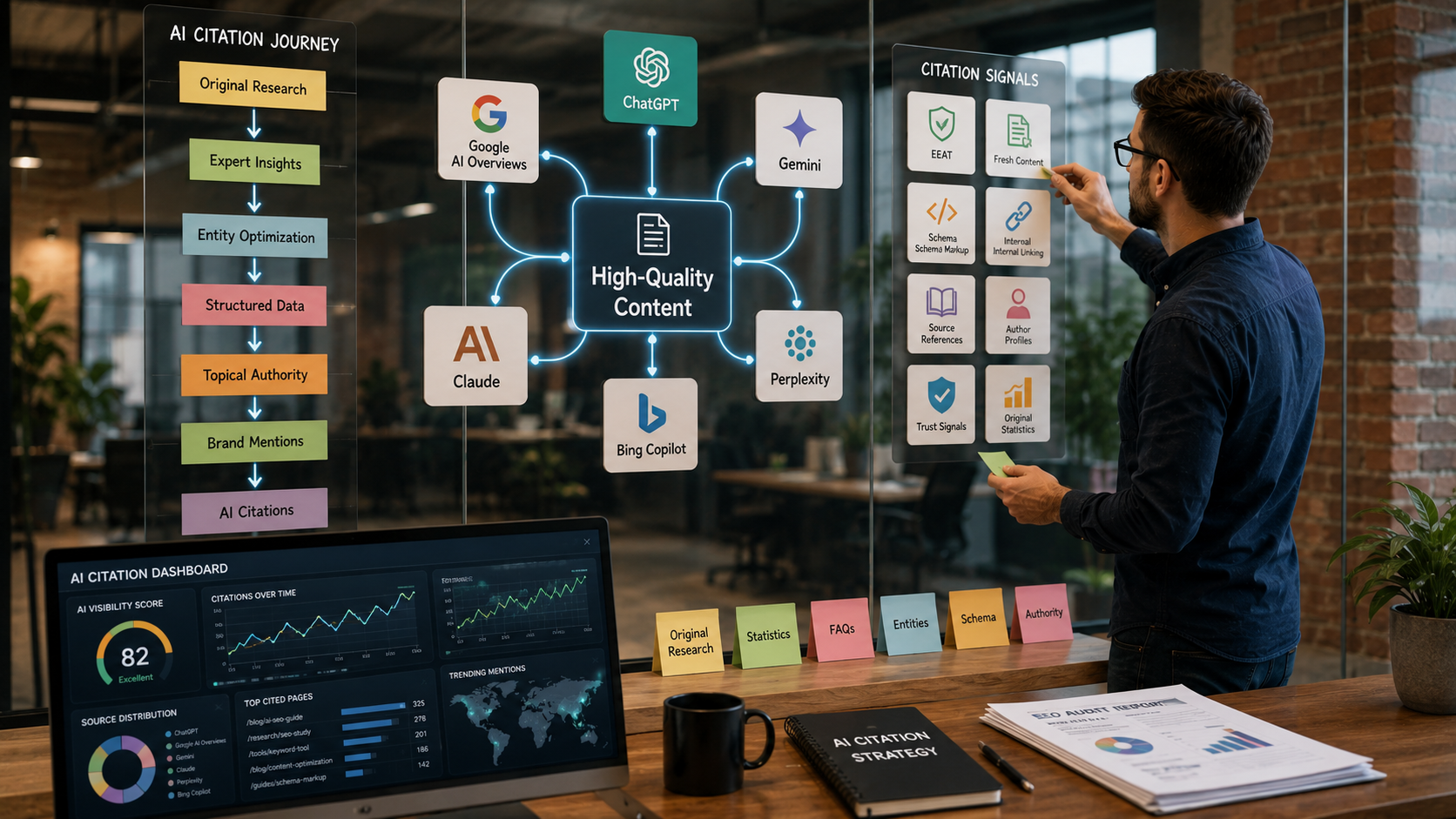
To get cited by AI, give answer engines content they can quote and trust. Lead each section with a direct answer. Back it with real statistics, quotes, and named sources. Add clean structure and schema so machines can read it. Then earn brand mentions across the web, so models learn who you are. This practice has a name: generative engine optimization, or GEO.
Traditional SEO gets you ranked. GEO gets you quoted. And quoting is where search is going. Google's AI Overviews now answer questions before anyone scrolls. Millions of buyers ask ChatGPT instead of Google. This guide shows you how to earn a spot inside those answers, using tactics backed by research, not guesswork.
Key takeaways
GEO means shaping your content so AI engines cite it in their answers. It sits on top of SEO, not against it.
A Princeton-led study found the right content changes lift AI visibility by up to 40%. Adding statistics, quotations, and cited sources worked best. Keyword stuffing did not (arXiv).
Only 34.5% of ChatGPT answers use a live web search. The rest come from training data (Semrush). So off-site brand mentions matter as much as on-page work.
Answer-first writing, clear structure, and valid schema make your pages easy to quote.
Track results with an AI citation tool. Perplexity reacts in days; Google and ChatGPT take months.
The goal of GEO: become the source an AI engine links to inside its answer.
What is generative engine optimization (GEO)?
Generative engine optimization is the practice of shaping content so AI answer engines cite it. Those engines include ChatGPT, Perplexity, Google AI Overviews, Gemini, and Copilot. GEO makes your pages easy for a model to read, quote, and trust.
It helps to see the difference from SEO. SEO earns you a ranked blue link. A person clicks that link and lands on your page. GEO earns you a mention inside the AI answer itself. The model reads your page, then names you in its reply. One drives clicks. The other drives influence.
Why care now? The click is shrinking. Gartner expects traditional search volume to drop 25% by 2026 (Gartner). Pew Research found that when Google shows an AI summary, people click a link only 8% of the time. Without a summary, that figure is 15% (Pew, via Search Engine Land). If the AI answer above you never names you, ranking first means less each quarter.
Citation capsule: Generative engine optimization (GEO) shapes your content so AI engines cite it in their answers. SEO earns a ranked link; GEO earns a mention inside the AI reply.
How do AI engines decide what to cite?
AI engines pull answers from two places: a live web search and their training data. This split matters more than most guides admit. Semrush studied over a billion lines of clickstream data. It found ChatGPT runs a live web search on only 34.5% of answers. The other two-thirds come from training data alone (Semrush).
So GEO has two jobs, not one.
The first job is to win live citations. When an engine searches the web, it wants a clear, quotable passage from a trusted page. Good structure and fresh, sourced content win here. You can influence this fast.
The second job is to build training-data presence. When a model answers from memory, no fresh page helps in that moment. What helps is having been mentioned across the web before the model was trained. Reviews, forum threads, and press coverage all feed that memory. This job is slower, but it shapes most answers.
Most tools only measure the first job. Keep both in view, or you will undercount your real reach.
Citation capsule: Roughly two-thirds of ChatGPT answers rely on training data, not live search. So getting cited by AI means winning live citations now and building brand mentions that shape future answers.
AI answers come from two sources. GEO has to serve both.
Which GEO tactics actually work?
We have real evidence here, not opinion. A Princeton-led team published the first study on GEO (arXiv). They ran thousands of queries through AI engines. They tested nine ways to rewrite content. Then they measured which changes earned more visibility inside AI answers.
The results were clear. The best changes lifted AI visibility by up to 40%. Three tactics led the pack:
Add statistics. Swap vague claims for specific numbers. "Faster" becomes "40% faster." Models favor concrete data.
Add quotations. Include a short quote from a credible expert or source. Quotes read as evidence, and engines lift them.
Cite your sources. Link to the studies and data behind your claims. Named sources signal that your page is trustworthy.
One finding surprised many marketers. Keyword stuffing was among the weakest tactics. At times it lowered visibility. The old SEO habit of repeating a phrase does not transfer to AI. Write for a reader, then add evidence.
The team tested nine changes in total. Beyond the top three, a few more helped:
Write fluently. Clear, flowing prose scored better than clunky text.
Use an authoritative tone. Confident, evidence-backed language earned more mentions.
Keep language simple. Easy-to-read pages were quoted more often.
Notice the pattern. Every winning tactic makes your content more credible, not more optimized. That is the core of GEO. Prove your point, and let the model quote the proof.
Citation capsule: A Princeton study found that adding statistics, quotations, and cited sources lifted AI visibility by up to 40%, while keyword stuffing was among the weakest tactics and sometimes reduced visibility.
The tactics that earn AI citations, ranked by the Princeton study. Evidence wins; stuffing loses.
How do the main AI engines differ?
Each engine cites content a little differently. You do not need a separate plan for each one. The core GEO work serves them all. Still, it helps to know how they behave.
Engine
What triggers a citation
Speed to cite
Best lever
Perplexity
Live search with a strong recency bias
Fast (days)
Fresh, well-sourced pages
ChatGPT
Training data, plus live search on some queries
Slow
Broad brand mentions over time
Google AI Overviews
Pages in Google's index, weighted by authority
Slow (weeks+)
Strong SEO, schema, and E-E-A-T
Gemini
Google's index and Google's own signals
Medium
Structured, authoritative pages
Copilot
Bing's index and live search
Medium
Bing indexing and clear answers
Two patterns stand out. Perplexity rewards freshness, so publish and update often. Google AI Overviews and Gemini lean on Google's index, so classic SEO still feeds them. Cover the fundamentals, and you show up across all of them.
Citation capsule: Perplexity cites fresh, well-sourced pages within days, while ChatGPT, Google AI Overviews, and Gemini favor established authority and take weeks or months to respond.
How to structure a page so AI can quote it
Structure decides whether a model can lift your answer cleanly. AI engines extract passages, not whole pages. Your job is to serve clean, self-contained chunks.
Start with the answer. Put a complete answer in the first one or two sentences of each section. A reader, and a model, should get the point before any setup. Save the backstory for later.
Write in blocks a model can quote. Keep each paragraph to one idea. Use headings phrased as real questions people ask. Add short definitions and clear steps. Use a table for any comparison of three or more things.
Add a TL;DR near the top. A three to five bullet summary gives engines a ready-made answer. It also helps skimming readers.
Keep sentences short. Short sentences are easier for a model to extract and reuse. They are easier for people too. Aim for plain words and one idea per line. You can check heading order with a free heading structure checker before you publish.
Citation capsule: AI engines extract passages, not whole pages, so put a complete answer in the first one or two sentences of every section and keep each paragraph to a single idea.
The technical setup: schema, crawlers, and llms.txt
Great content still needs a machine-readable wrapper. Three technical steps raise your odds.
First, add schema markup. Schema is code that tells engines what your content means. FAQPage schema maps to question-and-answer extraction. HowTo schema maps to step-by-step guides. Article schema with an author and a modified date signals freshness. Use JSON-LD format, since crawlers parse it most reliably. You can test yours with a free JSON-LD validator.
Second, let AI crawlers in. Engines send bots like GPTBot and Google-Extended to read your pages. Check that your robots file does not block them. If a bot cannot reach your page, it cannot cite it.
Third, consider an llms.txt file. This is a simple file that points AI systems to your key content. Adoption is early, and it is optional. It costs little to add and may help engines find your best pages.
For a full technical read on your own site, run it through an AI-focused site audit. It flags blocked crawlers, missing schema, and thin pages in one pass.
Build authority AI can corroborate
On-page work is half the battle. AI engines trust brands that show up in more than one place. They scan for agreement across sources before naming you with confidence.
Think about how a model builds trust. It sees your claim on your own site. Then it sees your brand on Reddit, on G2, in a YouTube tutorial, and in an industry article. The story lines up. Now the model feels safe recommending you.
So spread consistent signals. Earn honest reviews on the platforms your buyers read. Pitch a founder byline to a respected publication. Answer real questions in communities where your audience lives. Keep your positioning and facts the same everywhere.
This is slow work, and that is the point. It is hard to fake, so engines weight it heavily. It also feeds the training data behind most AI answers. For a deeper look at the tools that measure this, see our guide to the best AEO tools.
Citation capsule: AI engines look for agreement across independent sources before citing a brand, so consistent mentions on Reddit, review sites, and industry publications raise your citation odds as much as on-page changes.
Consistent mentions across the web tell AI engines your brand is safe to cite.
Common GEO mistakes to avoid
A few habits quietly hurt your AI visibility. Watch for these.
Keyword stuffing. The research showed it can lower visibility. Write for people first.
Burying the answer. A long intro pushes your quotable line out of reach. Lead with it.
Blocking AI crawlers. A blocked GPTBot cannot cite you. Check your robots file.
Unsourced claims. Numbers without a source read as opinion. Cite them.
Thin, generic pages. Models favor depth and specifics. Add real data and examples.
Set-and-forget content. Stale pages lose ground, since some engines favor freshness. Update on a schedule.
None of these are hard to fix. Most take an afternoon. Together they remove the roadblocks between your page and a citation.
How to measure your AI citations
You cannot improve what you cannot see. GEO needs its own measurement, since classic rank tools miss it.
Track three things. First, citation frequency: how often AI engines mention your brand for your target questions. Second, crawler activity: whether bots like GPTBot reach your pages, visible in your server logs. Third, referral traffic: the visits AI platforms send to your site, visible in your analytics.
Set your expectations by engine. Perplexity leans on fresh content, so it can cite new pages within days. Google AI Overviews and ChatGPT weight established authority, so they respond over weeks and months. Patience is part of the plan.
Start free if you are new to this. SEO Fragments' AI Citation Tracker checks whether ChatGPT, Perplexity, Gemini, Copilot, and Claude mention your brand. It scores your citation likelihood and flags competitor gaps. You bring your own API key, so it costs nothing to begin.
Your 30-day GEO plan
Here is a simple order of work. It moves from quick wins to slow, durable gains.
Week 1 — Structure. Rewrite your top five pages answer-first. Add a TL;DR and question-style headings to each.
Week 2 — Evidence. Add real statistics, one expert quote, and cited sources to those pages. Remove any keyword stuffing.
Week 3 — Technical. Add FAQPage and Article schema. Confirm GPTBot and Google-Extended are not blocked. Validate your markup.
Week 4 — Authority and tracking. Earn two or three honest brand mentions off-site. Set up an AI citation tracker and record a baseline.
Repeat the loop each month. GEO rewards steady effort, not a single sprint.
Conclusion
Getting cited by AI is not a mystery. Lead with the answer, prove it with data, and make your pages easy for machines to read. Then build the off-site mentions that teach models to trust you. The research is clear that these steps work, and most competitors have not started yet. That gap is your opening. Pick your five most important pages this week and rewrite them answer-first. Then run one free check to see whether AI engines mention your brand with SEO Fragments' AI Citation Tracker. Measure where you stand today, and you will know exactly what to fix first.
Frequently Asked Questions
How long does it take to get cited by AI?
Most sites see early gains within four to eight weeks of structural and schema changes. Perplexity can cite fresh pages within days because it favors recency. Google AI Overviews and ChatGPT take longer, since they weight authority that builds over months.
Can I get cited by ChatGPT for free?
Yes. Free tools like SEO Fragments' AI Citation Tracker check ChatGPT mentions using your own API key. The on-page work — answer-first writing, adding sources, and valid schema — costs nothing but time. Paid tools mainly add history, scale, and competitor tracking.
Does GEO work without good SEO?
Not well. AI engines often pull from pages that already rank and get indexed. Strong SEO gives models a page to find in the first place. GEO then raises the odds that they quote it. Treat GEO as a layer on top of SEO, not a replacement.
Which AI engine is easiest to get cited by?
Perplexity is usually the fastest. It leans on live search and recent content, so new pages can appear within days. ChatGPT and Google AI Overviews are slower, because they favor established authority signals that take longer to earn.
What content do AI engines cite most?
Clear, well-sourced answers. A Princeton study found that adding statistics, quotations, and cited sources raised AI visibility the most. Engines favor pages that answer directly, back claims with data, and read as trustworthy. Keyword-stuffed pages perform worse.
How do I know if AI is citing my site?
Use an AI citation tracker to test your target questions across engines and see if you appear. Check your server logs for AI crawlers like GPTBot. Watch your analytics for referral traffic from ChatGPT, Perplexity, and other AI platforms.