AI Visibility Audit: A Practical 5-Step Guide
An AI tool can recommend your competitor while ignoring your brand. It can also name you without linking to your site. Both results affect visibility, but they don't have the same value.
We saw this difference while auditing SEO Fragments. The site allowed major AI search crawlers and had clear structured data. Yet those technical signals alone couldn't prove that AI answers mentioned or cited the brand.
So, how do you learn what AI search tools say about your company?
You run an AI visibility audit. It tests real questions across AI engines. It records mentions, citations, competitors, and message accuracy. This guide shows you how to run one in five steps.
What Is an AI Visibility Audit?
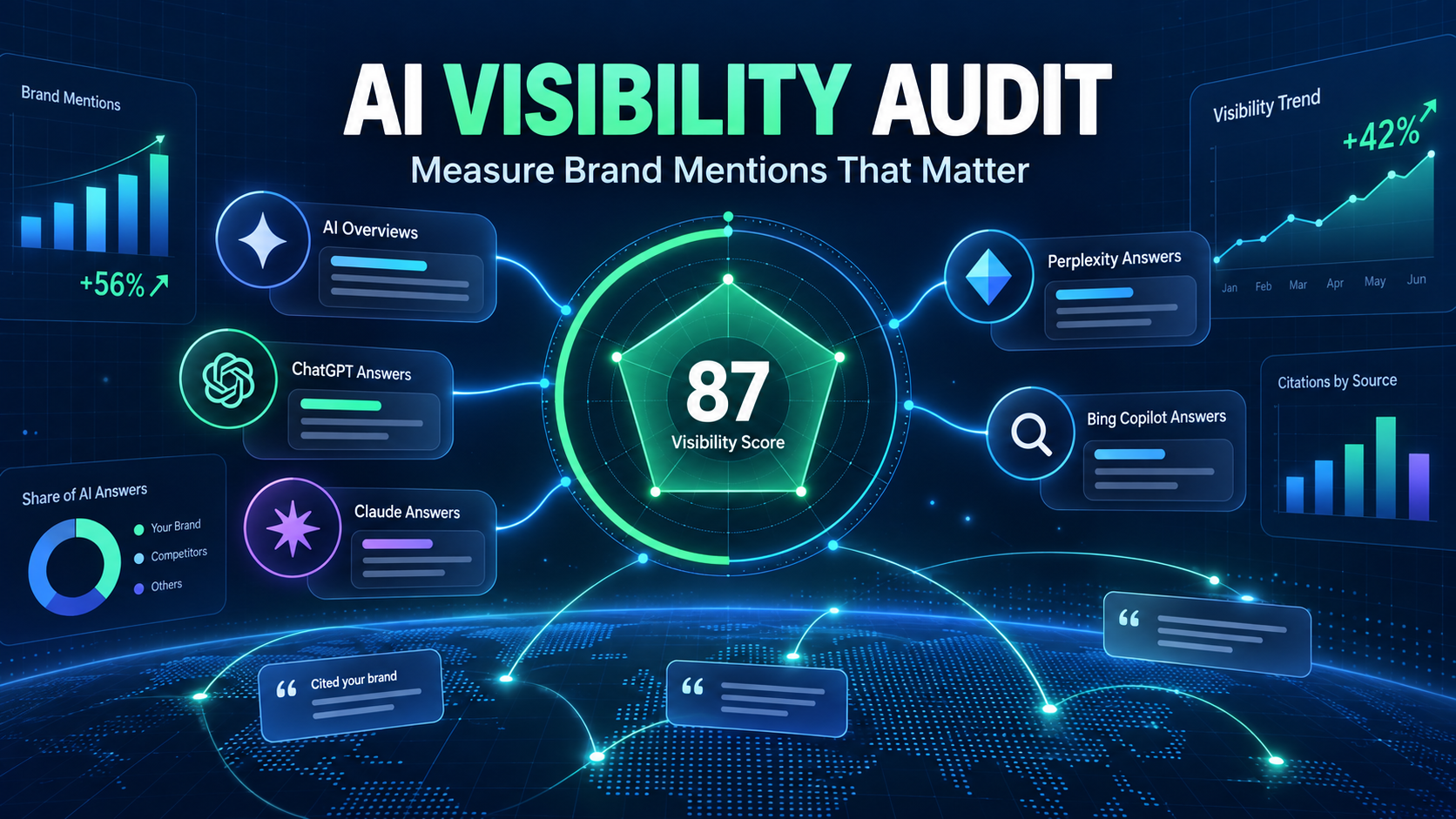
An AI visibility audit measures how often AI answer engines mention, describe, and cite a brand. It also shows which competitors appear for the same questions.
This differs from rank tracking. An AI audit studies generated answers that may change between runs.
It should answer six questions:
- Does the engine mention your brand?
- Does it link to your website?
- Is the description accurate?
- Which competitors appear beside you?
- Which sources support the answer?
- Does that exposure lead to useful visits or sales?
A mention is not the same as a citation. The engine may name your product without giving users a link. A citation gives people a path to your page. That makes citation rate a stronger traffic signal.
Separate search discovery from AI training. OpenAI uses OAI-SearchBot for search discovery and GPTBot for possible model training.
OpenAI's publisher guidance says sites should allow OAI-SearchBot to support discovery in ChatGPT search. It also says ChatGPT referral links include utm_source=chatgpt.com.
Google's AI features guidance says normal SEO rules still apply. Pages must be indexed and able to show snippets.
Choose the Questions That Matter
Your audit starts with prompts, not tools. Pick questions a real buyer would ask before choosing a product or service.
Use four prompt groups:
- Category prompts: “What are the best AI SEO tools for freelancers?”
- Problem prompts: “How can I track whether ChatGPT mentions my company?”
- Comparison prompts: “What are affordable alternatives to Semrush?”
- Brand prompts: “What is SEO Fragments, and is it reliable?”
Start with 20 to 30 prompts. That is enough to spot patterns without creating a messy test.
Write each prompt as a user would speak. Don't put your brand in every question. Most prompts should test discovery without help. Label each prompt by buyer stage and intent.
Keep your prompt list stable for later audits. If you replace every question each month, you can't compare the results.
Test Several AI Search Engines
Test the platforms your audience uses. This may include ChatGPT search, Google AI features, Perplexity, Microsoft Copilot, and Claude.
Use the same prompt, location, and account state where possible. Save the full answer, not only the brand name. You need the surrounding words to judge accuracy and intent.
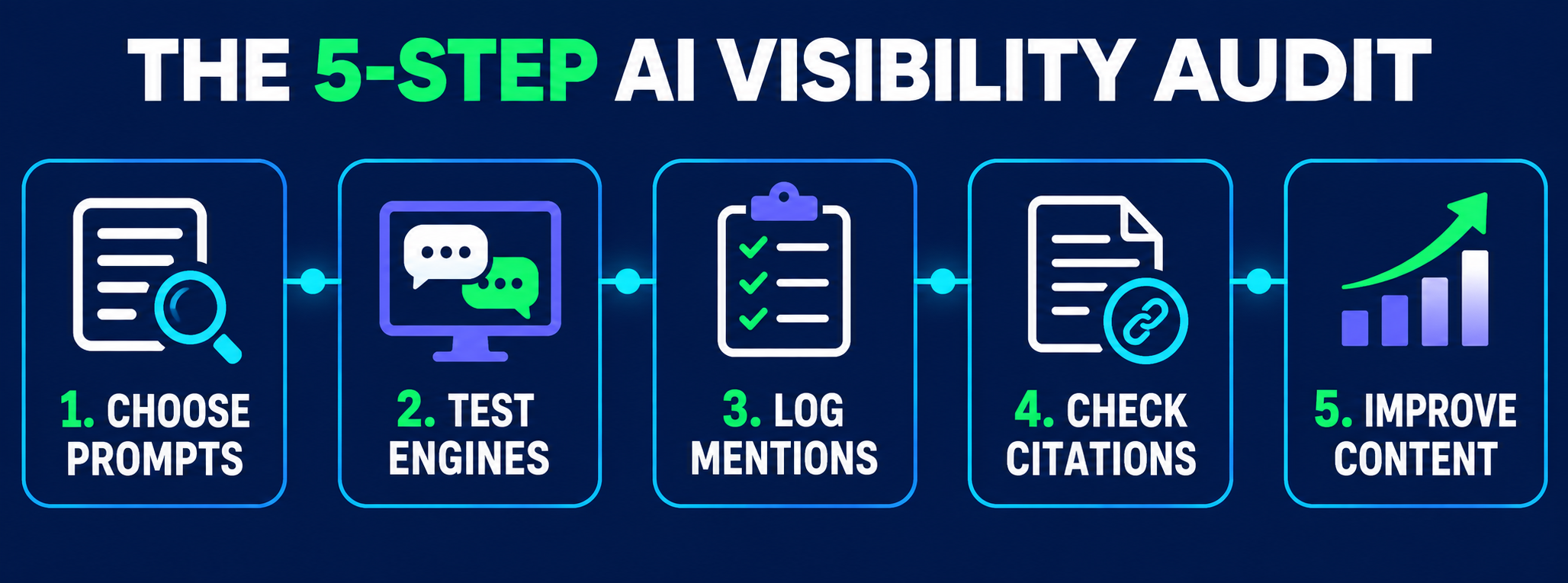
Choose prompts, test engines, log mentions, check citations, and improve the pages that support each answer.
Follow this process for every test:
- Open a fresh conversation.
- Enter one saved prompt.
- Copy the complete answer.
- Record the date and engine.
- Save every linked source.
- Repeat the test at least twice.
Generated answers vary. One run may cite your brand while the next leaves it out. One result is not a trend.
Manual testing works for a small prompt set. Regular monitoring needs a repeatable system. The SEO Fragments AI Visibility Monitor is designed to track brand citations and changes over time. You can also begin with the free Brand Monitor.
Check how each tool gets its data. See the SEO Fragments transparency report for its data labels.
Measure Mentions, Citations, and Accuracy
Don't reduce the audit to one score. A high score can hide weak sources or wrong product details.
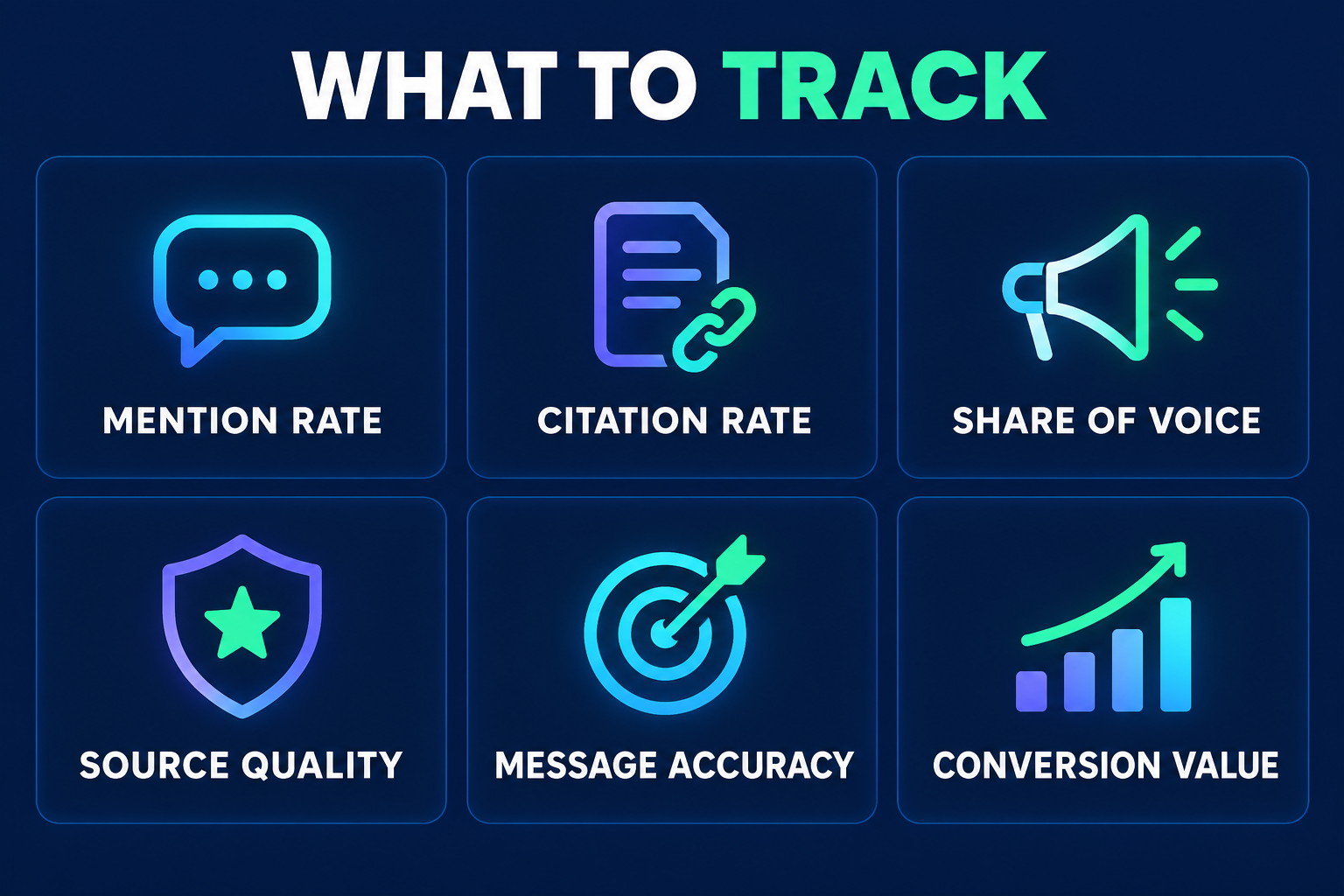
Use these six measures:
| Metric | What it measures | Simple calculation |
|---|---|---|
| Mention rate | How often the brand appears | Brand mentions ÷ total prompts |
| Citation rate | How often an answer links to the brand | Linked mentions ÷ total prompts |
| Share of voice | Your presence against competitors | Your mentions ÷ all tracked brand mentions |
| Source quality | The value of cited pages | Review authority, relevance, and freshness |
| Message accuracy | Whether facts are correct | Accurate claims ÷ claims checked |
| Conversion value | Business results from AI visits | Leads or sales from AI referrals |
Score each result as positive, neutral, or negative. A linked recommendation is positive. An outdated price or false claim is negative.
Check which page earned the citation. AI answers may favor a focused guide, comparison, help page, or original study.
For Google, use Search Console alongside your audit. Google says pages shown in AI features appear in its performance reporting. Use analytics to study what visitors do after they arrive.
For ChatGPT traffic, filter utm_source=chatgpt.com. Track signups and sales, not visits alone.
Improve the Content Behind the Answer
An audit has no value if it ends in a spreadsheet. Turn each gap into a clear content or technical task.
Start where competitors appear and you don't. Study what proof or format their cited pages provide.
Then improve your strongest relevant page:
- Give the main answer near the top.
- Use clear question-based headings.
- Add original tests, screenshots, and examples.
- Cite primary sources beside important claims.
- Show the author and reviewer.
- Display a real update date.
- Keep prices and feature claims current.
- Add structured data that matches visible content.
- Link to the page from related site sections.
Google recommends original, people-first content. It warns that mass AI production without added value may break scaled-content rules. Review its generative AI content guidance.
Make sure crawlers can reach the page. Check its canonical, noindex tag, internal links, sitemap, and server response.
Don't treat llms.txt as a magic ranking file. It can describe your site to machines, but Google says it is not required for AI Overviews or AI Mode. Strong content and normal indexability come first.
Avoid These AI Visibility Audit Mistakes
Testing only branded prompts: A question containing your company name almost forces a mention. Include broad category and problem prompts.
Counting every mention as a win: A wrong price or negative description can harm trust. Read the complete answer.
Checking one engine once: AI answers vary across engines and runs. Repeat tests on a fixed schedule.
Using changing prompts: Keep a core prompt set. Add new questions without removing the baseline.
Ignoring source pages: The cited URL tells you what the engine trusts. Study its format, evidence, author, and freshness.
Tracking traffic without outcomes: Ten qualified visits may beat 1,000 weak impressions. Connect AI referrals to signups, trials, leads, or sales.
Publishing thin pages for every prompt: This creates clutter and weak content. Build fewer pages with better proof and clearer answers.
A Simple Monthly Audit Setup
Most small teams can start with:
- 25 core prompts across four intent groups
- Four AI engines used by your audience
- Two runs per prompt to reduce random noise
- Six metrics from the table above
- One monthly review with content and technical owners
That creates 200 checks per audit. Use the GEO tools hub to check access, answer structure, citations, and entities. Pick one or two improvements, then test again after recrawling.
Aim to become a reliable source for questions closest to your product and expertise.
Conclusion
An AI visibility audit shows whether answer engines know your brand, trust your pages, and send useful visitors. It goes beyond a simple mention count by checking citations, competitors, accuracy, source quality, and conversions.
Start with 25 real buyer questions. Test them across several engines, save every answer, and build a monthly baseline.
Run your first check with the AI Visibility Monitor, then improve the pages behind your weakest results. Which buyer question do you most want an AI engine to answer with your brand?
Frequently Asked Questions
What is an AI visibility audit?
An AI visibility audit checks how often AI answer engines mention and cite a brand. It also reviews competitors, source pages, accuracy, sentiment, and referral value.
How often should I run an AI visibility audit?
Run a core audit once each month. Check important launch, pricing, or reputation prompts more often when your business changes.
What is the difference between a mention and a citation?
A mention names your brand. A citation links to a source page. Citations are more useful for referral traffic because users can visit the supporting page.
Can I track traffic from ChatGPT?
Yes. OpenAI says ChatGPT search adds utm_source=chatgpt.com to referral links. Filter that source in your analytics platform and connect it to conversions.
Does schema guarantee an AI citation?
No. Schema helps machines understand a page, but it cannot guarantee a citation. The markup must also match the visible content.
Do I need an llms.txt file for Google AI Overviews?
No. Google says no special AI text file or schema is required. Standard crawling, indexing, content quality, and page experience still matter.
Building 120+ free AI-powered SEO tools — every article is written and tested with them. About us
Try the tools we used
All articles are written with SEO Fragments. Sign in free and use the same tools.
Get started free →Read next
- Keyword Cannibalization: Find and Fix Competing PagesDiagnose keyword cannibalization, identify your strongest page, and choose the right fix without deleting content that still serves a valuable purpose.
- AI SEO Audit: How to Audit Your Website in 2026Run a complete AI SEO audit in 2026: what to check, the free tools for each step, and the AI-visibility gaps that classic audits miss. A step-by-step guide.
- Answer Engine Optimization: Prepare Content for AI SearchLearn Answer Engine Optimization (AEO) to help AI search engines understand, trust, and cite your content across ChatGPT, Google AI, Gemini, and Perplexity.