Claude Haiku 5.5: The Small Model That Wants to Do the Busy Work
The most useful AI model is not always the largest one. Many real tasks are short, repeated, and time-sensitive. Think of sorting support tickets, pulling a field from a document, routing a request, or checking a browser step. Those jobs need a model that is quick, reliable, and inexpensive enough to run thousands of times.
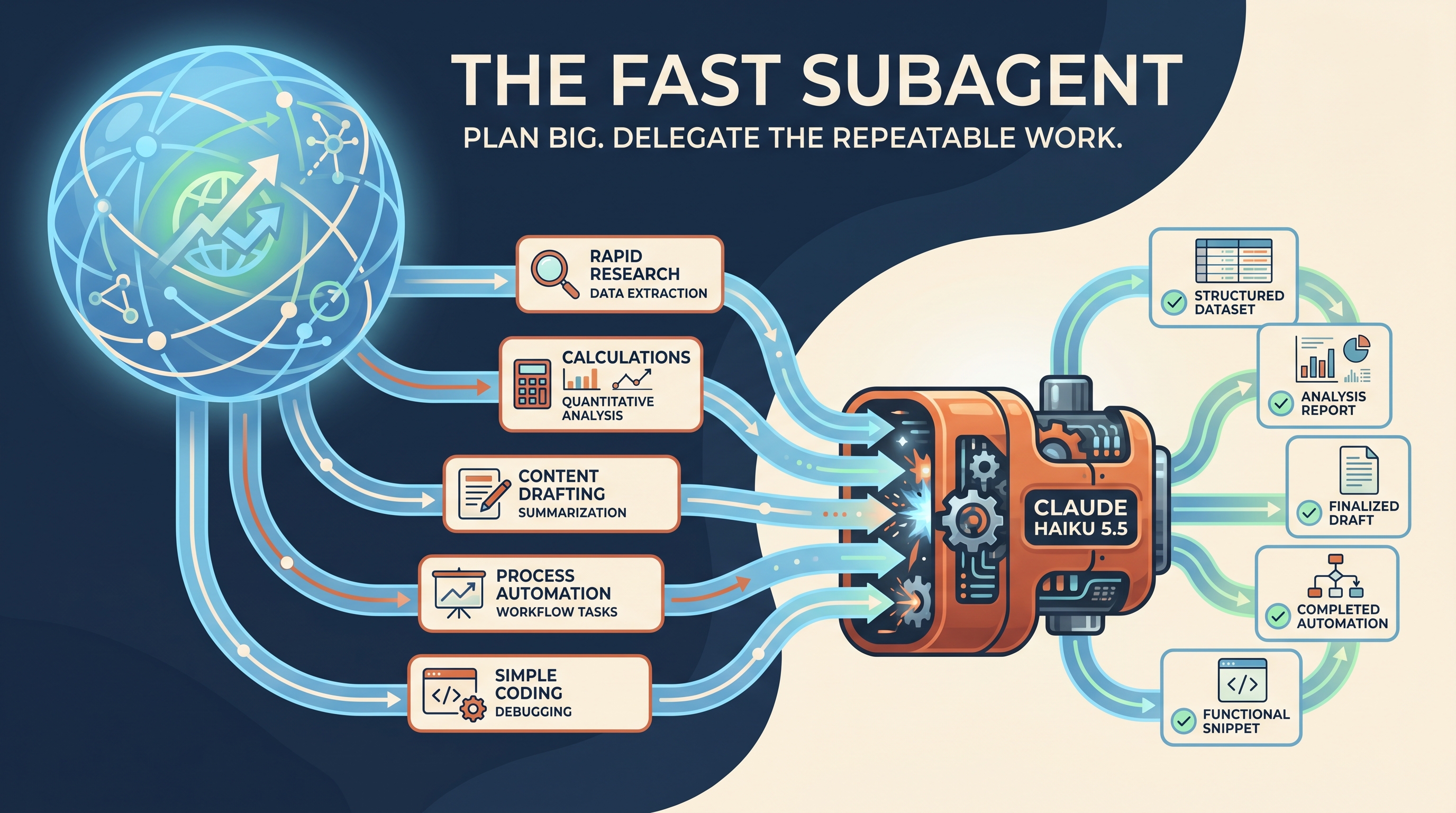
That is the role Anthropic has given Claude Haiku 5.5, released on October 7, 2026. Anthropic calls it the cheapest, fastest, and most capable small model it has released. It is built for high-volume work or as a fast subagent inside a larger AI system.
For teams building AI products, that distinction could matter more than another headline benchmark.
What Claude Haiku 5.5 is built to do
Haiku 5.5 is aimed at classification, extraction, routing, summaries, document compaction, database queries, and quick lookups. These routine jobs can make an AI workflow slow or expensive at scale.
It is also designed for live customer support and browser use, where response time changes the user experience. In coding workflows, Anthropic positions Haiku as a subagent. A larger model can plan a feature or write a complex change. Haiku can then search files, collect facts, run smaller checks, or summarize results.
The numbers that matter: context, output, and thinking
The model has a one-million-token context window and a 128,000-token maximum output. The Message Batches API can reach 300,000 output tokens in beta. It can therefore read large collections of text without large-model pricing.
Haiku 5.5 also has adaptive thinking. Its default effort setting is medium, and developers can choose more effort when a task needs deeper reasoning.
Haiku 5.5 uses Anthropic's newer tokenizer. The same text can count as about 30% more tokens than it did with Haiku 4.5. Compare cost on real prompts, not only on the price card.

Claude Haiku 5.5 pricing: why the model is notable
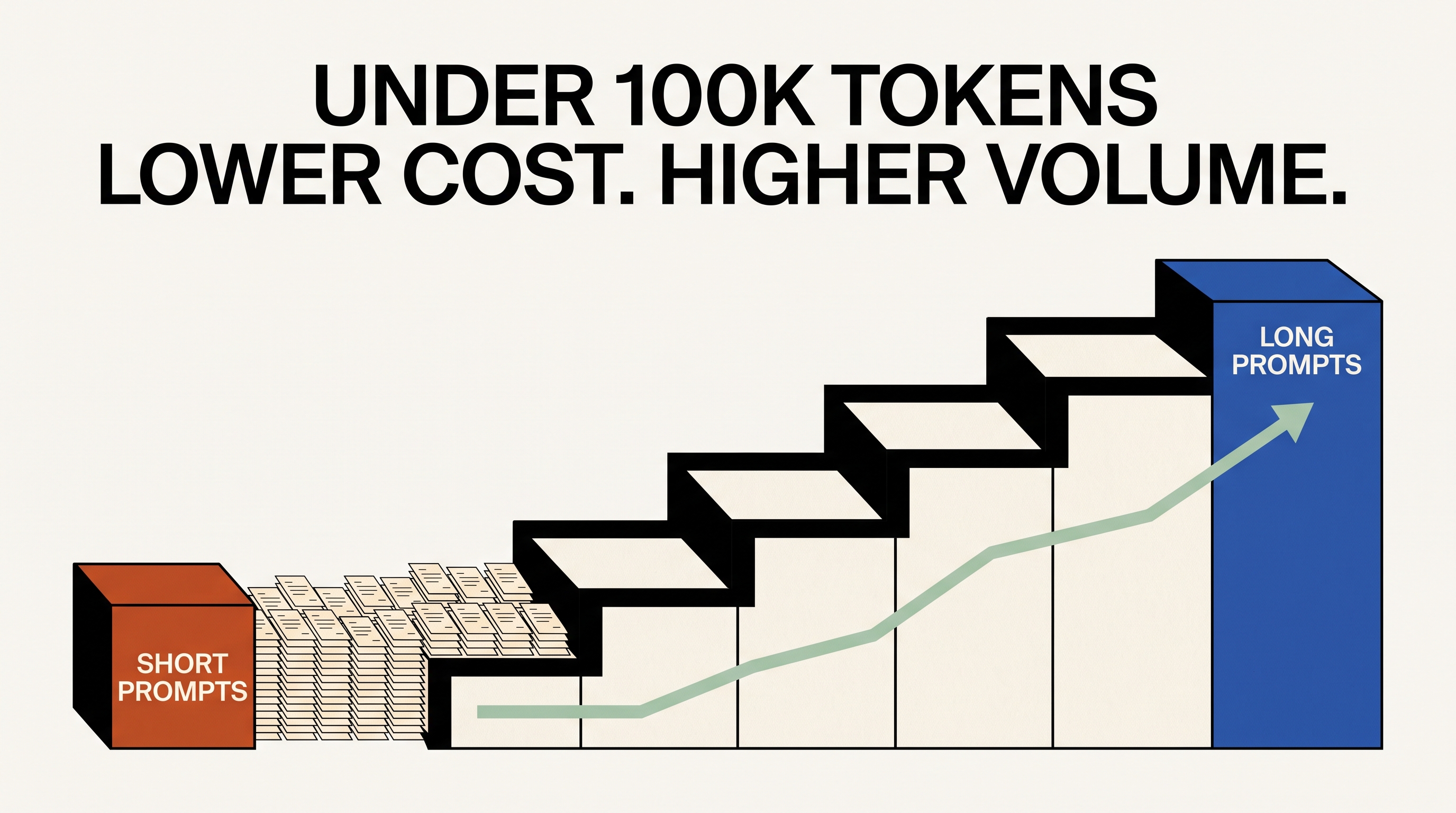
For prompts up to 100,000 tokens, Haiku 5.5 costs $0.10 per million input tokens and $0.50 per million output tokens. Above 100,000 tokens, the rates become $0.50 input and $2.50 output per million tokens. Cache reads start at $0.01 per million tokens for the smaller prompt tier. Batch API input and output receive a 50% discount.
Anthropic says this pricing is 90% lower than Haiku 4.5 for requests up to 100,000 tokens and 50% lower for longer requests. It puts the average saving at about 75%, after accounting for the new tokenizer. About 90% of Haiku 4.5 requests fell under the lower tier.
Use Haiku for volume, not as a shortcut for difficult work. A cheap model becomes costly if it causes retries or extra review.
Benchmarks: a huge jump over Haiku 4.5
Anthropic's own results show a major gain over Haiku 4.5. On OSWorld 2.1, a computer-use benchmark, Haiku 5.5 scored 72.4% on the offline subset, compared with 15.7% for Haiku 4.5. On Terminal-Bench 4.0, it scored 39.2%, while Haiku 4.5 scored 0.0% in Anthropic's table. It also reached 46.4% on FrontierCode and 57.4% on Humanity's Last Exam with tools.
The model does not lead every task. Sonnet 5.5 remains stronger for complex agentic coding. Use smaller models for routine steps and save larger models for judgment-heavy work.
Early customer reports support the speed story but remain vendor-supplied case studies. Asana reported over 30% lower task-completion latency and up to 2.5× faster inference per agent turn. HubSpot reported a 92.8% average score on its CRM test suite.

Safety and availability
Anthropic says Haiku 5.5 shows fewer examples of misaligned behavior and less willingness to help with misuse than Haiku 4.5. Its cybersecurity safeguards are stricter than the earlier Haiku model. Defensive work is allowed more broadly than under Sonnet 5.5's rules, while penetration testing and attack-oriented techniques remain blocked.
The model is available now through the Claude API, Amazon Bedrock, Google Cloud, Microsoft Azure, and Claude Platform on AWS. The API model ID is claude-haiku-5-5. Developers should also note that non-default temperature, top_p, or top_k values return a 400 error for this model.
Anthropic also halved Sonnet 5.5 cache-read pricing, which it says makes most agentic work about 20% cheaper. It began rolling out monthly API credits for Max and Team users to support agent testing.

Video: a practical overview
AI Words Explained reviews Haiku 5.5's pricing and role in high-volume AI workflows. This is an independent video, not an Anthropic production.
The practical takeaway
Claude Haiku 5.5 is a strong option when the job is clear, repeated, and sensitive to latency or cost. It is particularly compelling for support automation, document extraction, routing, browser steps, and subagent work.
Do not choose it only because it is cheap. Test it on real tasks. Measure accuracy, latency, retries, review time, and total cost. Then route only the work Haiku can perform reliably.
Frequently asked questions
Is Claude Haiku 5.5 available now?
Yes. Anthropic lists it as active on its API, Amazon Bedrock, Google Cloud, Microsoft Azure, and Claude Platform on AWS.
How much does Claude Haiku 5.5 cost?
For prompts up to 100,000 tokens, it costs $0.10 per million input tokens and $0.50 per million output tokens. Longer prompts cost more.
What is the Claude Haiku 5.5 context window?
It has a one-million-token context window, with a 128,000-token standard output limit.
Is Haiku 5.5 good for coding?
It can work well as a coding subagent for narrow tasks. For complex, long-running agentic coding, Anthropic recommends Sonnet 5.5 or Opus 5.5 instead.
What are the best Claude Haiku 5.5 use cases?
Classification, extraction, routing, summaries, database queries, quick document lookups, live support, browser use, and high-volume subagent work are the best fit.
Sources
Building 120+ free AI-powered SEO tools — every article is written and tested with them. About us
Try the tools we used
All articles are written with SEO Fragments. Sign in free and use the same tools.
Get started free →Read next
- Claude Sonnet 5.5: Features, Pricing and BenchmarksClaude Sonnet 5.5 promises faster coding and polished knowledge work at Sonnet pricing. Here is what changed, what it costs, and where it fits.
- Gemini 4 Argon Explained: Access, Price and BenchmarksGemini 4 Argon promises long-running AI workflows, strong coding and a 1M-token output limit. Here is what Google announced—and what remains unknown.
- AI Visibility Audit: A Practical 5-Step GuideAn AI tool can recommend your competitor while ignoring your brand. It can also name you without linking to your site. Both results affect visibility, but they…